Site Logistics Manager

About 20% of the field labor hours are spent on material logistics and daily mobilization, demobilization to the work area.

D. Brown Management Profile Picture
Share

What if you could shift 5% of the time spent on logistics to installation while accelerating your foreman development?
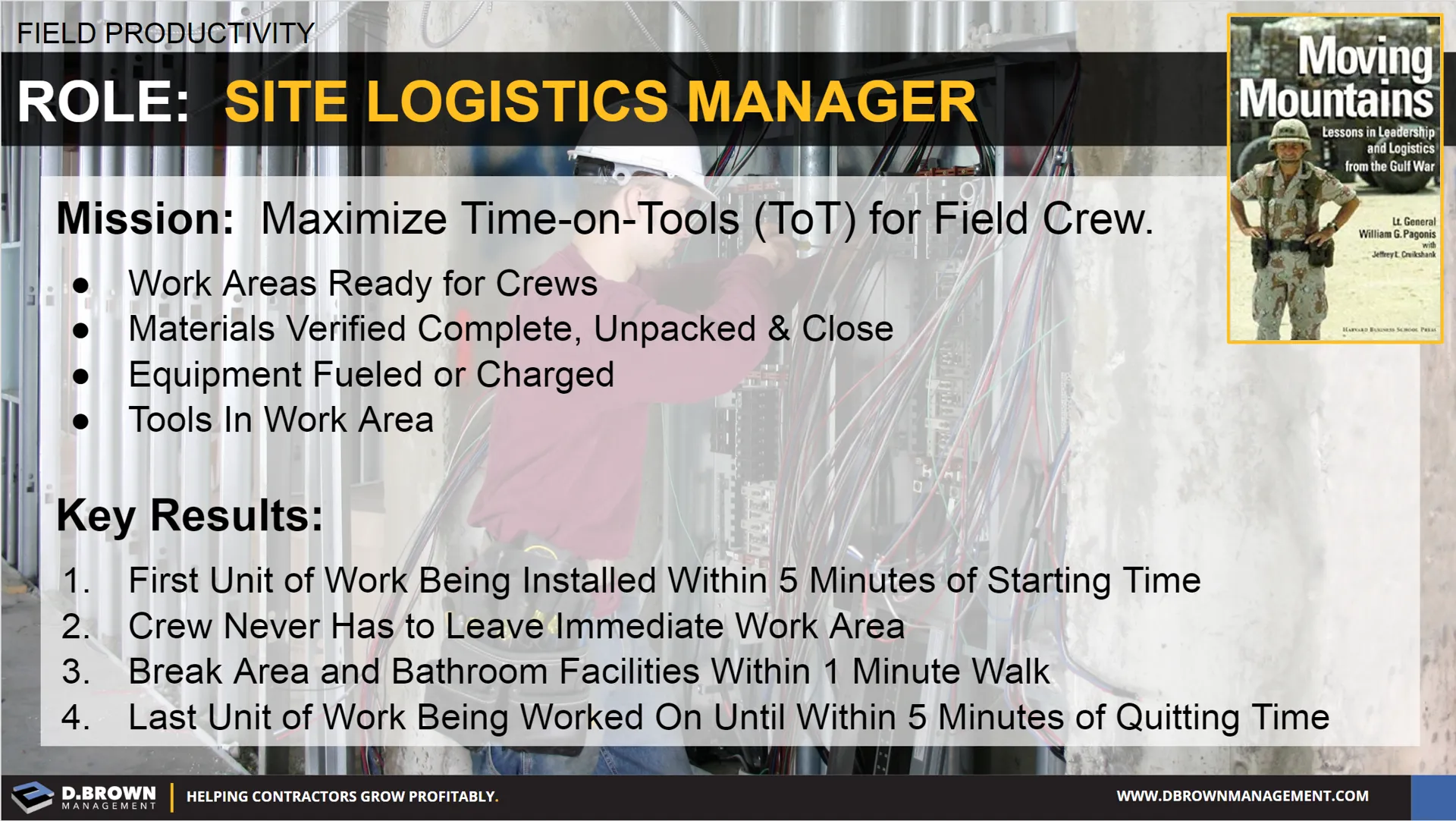
Field Productivity: Role as a Site Logistics Manager. Mission: Maximize Time-on-Tools (ToT) for Field Crew. 4 Key Results.

Depending on the work study only 50-64% of the work hours are spent on actual installation or “Time-on-Tools”.  

For a $50M per year specialty contractor with labor being about 35% of their job costs this is a savings of OVER $1,000,000 per year.  

Consider changing the role of “Material Handler” being an entry-level person to a role of “Site Logistics Manager.” 

Fill this role with a high-potential crafts person who has already demonstrated capabilities as a lead person overseeing a few people.  This is a role they will fill before being given their own job to run.  

They have 100% accountability for 3 of the 6 pillars of productivity:

They serve as the “Right Hand” and “Second-in-Command” to the Foreman, General Foreman or Project Superintendent who focus on the other 3 pillars of productivity:

  • Right labor scheduled to the right areas of the jobsite.
  • Given the right information for an effective install.
  • Clear production goals set and managed.

The military assigns Generals to run logistics.  Why do contractors typically assign entry level people for something that eats up 20% of the labor?  


Learn more


Site Logistics Manager
Field labor is the often the biggest variable on a construction project - making it the biggest risk and opportunity....

Site Logistics Manager
Field labor is the often the biggest variable on a construction project - making it the biggest risk and opportunity....

Lean Principle - Observation (Gemba Walks and Learning to See)
One of the most important tools for improving productivity is going to the jobsite or work area and observing for an extended period of time with the intent to understand but not to immediately interact. Observation progresses through about 7 stages.
Discipline Vs. Motivation
Leadership requires a balance between motivation and discipline. These are two very different things and if you are relying on motivation to keep you going it is likely that you will come up short on long-term goals.
Communicating as a Leader
Leadership is about the ability to influence and align people. And that is largely about effective communication and consistent actions.