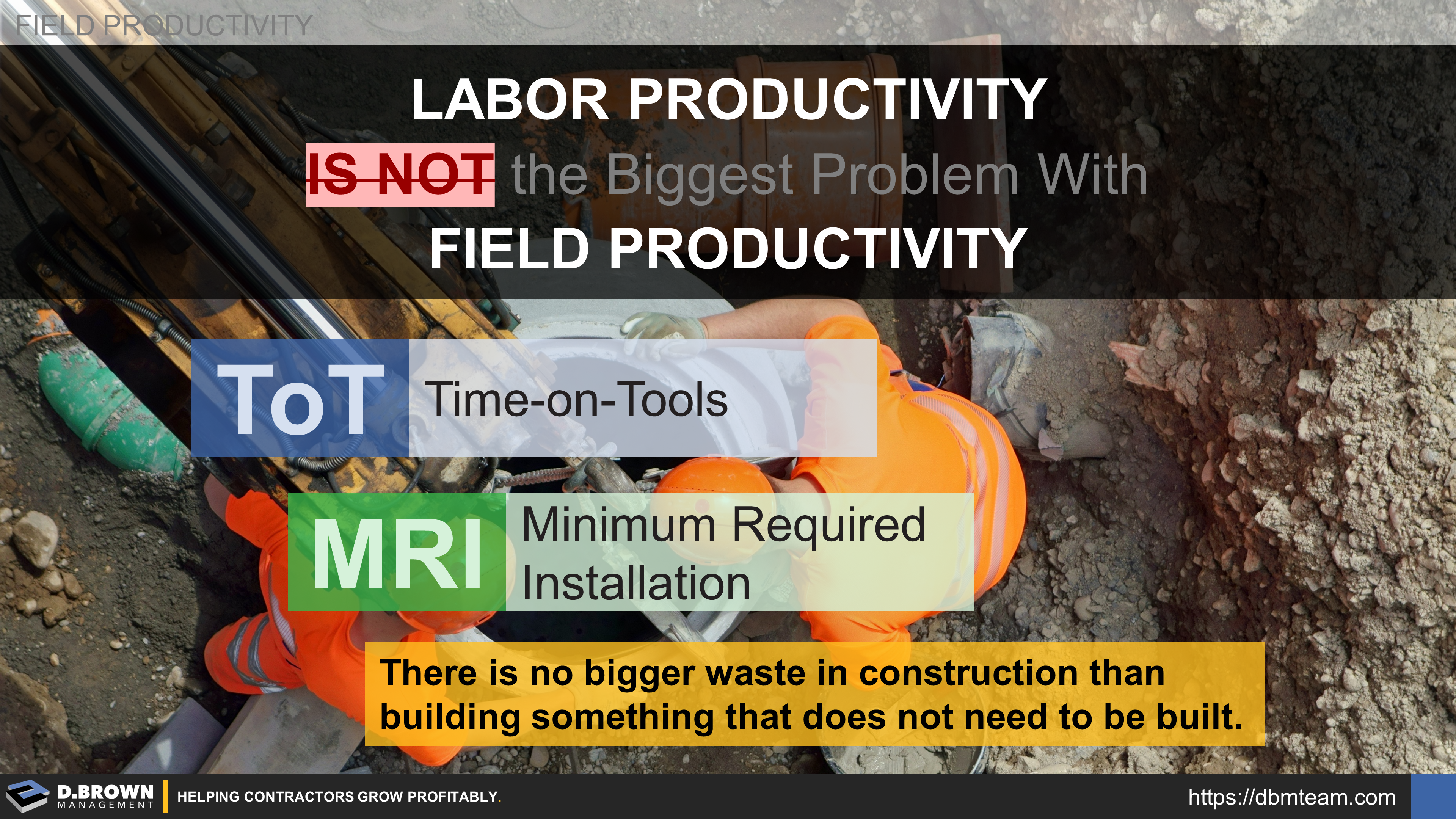
Time-on-Tools and Minimum Required Installation

Labor productivity IS NOT the biggest problem with field productivity. Under similar conditions the variation in how fast two crafts people actually “turn wrenches” is about 2X but there are far bigger problems to tackle. Focus on these three areas.

D. Brown Management Profile Picture
Share


Field Productivity: Labor Productivity IS NOT The Biggest Problem With Project Productivity


  1. Maximize Time-on-Tools (ToT): Ensure that crafts people spend most of their day working with their tools actually installing things.  Different studies place the industry average between 50-65%.  Leverage the 6 Pillars of Productivity and ABC Daily Planning.  
  2. Minimum Required Installation (MRI): Don’t take critical shortcuts but don’t over-build the project.  In the field we would call it “Gold Plating.” Effective installation details, craft training and good field supervision practices will ensure that you get the right level of quality. 
  3. Minimize Rework: The only greater waste than installing more than what is required is doing it twice.

General Contractors and Project Owners can do a lot to set the conditions for success with their labor-intensive subcontractors. 


4 Elements of an Effective Task

Site Logistics Management


Time-on-Tools and Minimum Required Installation
Field labor is the often the biggest variable on a construction project - making it the biggest risk and opportunity....

Related Training
Time-on-Tools and Minimum Required Installation
Field labor is the often the biggest variable on a construction project - making it the biggest risk and opportunity....

Managing All Deliverables - Beyond the Basic Submittal Log
Maximize your people, projects, profitability, and customer relationships by making your submittal log and process a little less "efficient" and a whole lot more effective.
Lean Principle - People First (Then Process and Tools)
To optimize productivity, a contractor must focus on their people first, then processes and tools including technology as an integrated management system with a hierarchy. This is not a linear process: S.M.A.R.T. Experiments + Continuous Improvement.
Lean Principle - Value Add vs. Non Value Add
For specialty contractors the field workforce represents most of their competitive advantage as well as their biggest source of variability. Making improvements to field productivity requires deeply understanding what truly adds value to the customer.