Changing a Good Decision Making Process Based on Results

Construction projects are complex requiring thousands of decisions made across dozens of teams over many months to ultimately result in a good outcome

D. Brown Management Profile Picture
Share
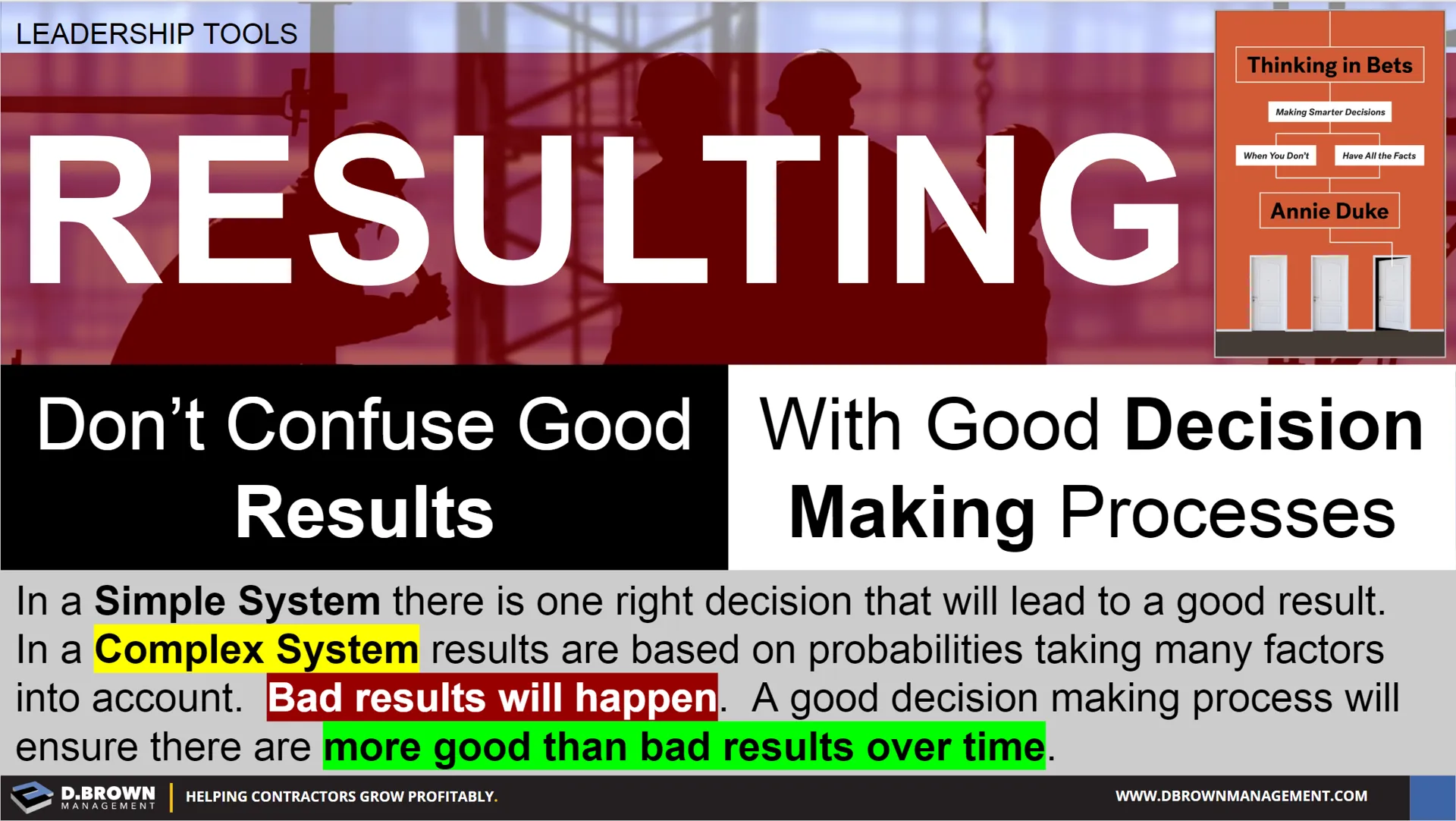
Leadership Tools: Resulting. Don't Confuse Good Results with Good Decision Making Processes. Book: Thinking in Bets by Annie Duke.

As a leader in the construction industry the majority of your value-add is:

  1. Making good decisions
  2. Ensuring those decisions are executed
  3. Teaching others how to do the same  

In a simple system the decision tree may have a few known variables and a single clear path which is easily trainable.  

Most project decisions are more complex having more variables and outside influences impacting results over a longer time span.  Given time pressures and limits of the human brain only a few of those variables can be accounted for accurately in our mental model of a situation.  

The results of a good decision making process are not 100% good but the average results over time are good.  Resulting is a term used in poker when a player starts changing a good decision making process based on the resulting outcomes.  This seems logical but will lead to an overall decline in results with increased variability.   

Smarter, Faster, Better


Contact us to learn how we train teams to make better decisions


The Contractor Scoreboard - A Contractor Must Do 3 Things
This outcome-based scoreboard keeps everyone focused on what matters. Avoid metric overload and diffusion of resources. All other metrics throughout all levels of the organization fall into a hierarchy below these with priorities changing over time.
Definition - Capacity
How Much of something (capability) a person, team, or company handle. Consider this in ranges of comfortable (sustainable) and peak (sprints).
Evaluation Categories and Weighting
Whether you are evaluating your own performance or someone else’s, it is important to start thinking about some of the higher level categories. The weight assigned to each of these depends on the stage someone is at in their career.