Contractor Exit Strategy 3 of 6: Strategic Sale to an Outside Buyer

Every contractor wants a strategic sale to an outside buyer.

D. Brown Management Profile Picture
Share

Specifically, an outside buyer that sees such a strong strategic fit with their business that they are excited to pay a 6X earnings multiple of the best performing year the contractor has had during the last three years in cash. 
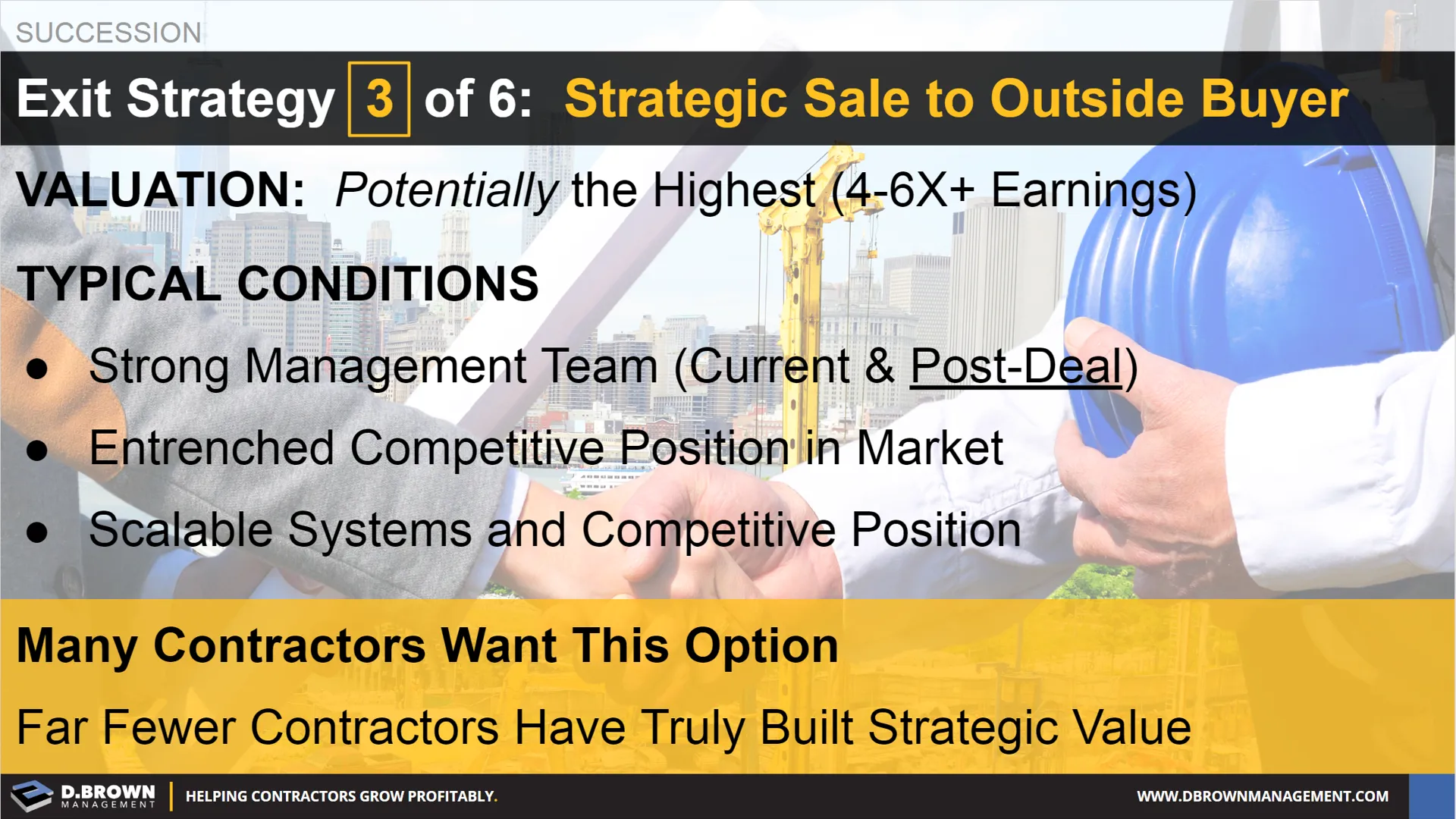
Succession: Exit Strategy 3 of 6 - Strategic Sale to Outside Buyer.

Fact: Most media coverage of deals is either a strategic sale or a catastrophic liquidation through bankruptcy. This can skew a contractor’s view of the market.  

Fact: Only a small percentage of ownership transitions could be considered strategic sales with high valuation multiples.

Fact: The only way a high valuation makes sense for the buyer is if the contractor has either a competitive position, technology, or process that can be scaled up significantly with access to more capital or other operational assets the buyer has. The ROI (Return-on-Investment) still must pencil out for the buyer.  

Fact: Few contractors have truly built highly scalable competitive advantages that make this type of exit an option.  

Fact: If you have truly built scalable competitive advantages that require more capital to execute then an outside strategic buyer is your only option.  


Contractor Exit Strategy 3 of 6: Strategic Sale to an Outside Buyer
Continue building value in your business, yourself and your key team members with a good succession strategy....

Contractor Exit Strategy 3 of 6: Strategic Sale to an Outside Buyer
Continue building value in your business, yourself and your key team members with a good succession strategy....

Directly Responsible Individual (DRI)
Defining a single Directly Responsible Individual (DRI) for an outcome is a foundation of effective process and organizational design. It is often misused when the individual doesn't have the right capabilities, capacity, authority, or management.
3-Year Business Planning (Basic Overview)
Your 3-Year Business Plan is the equivalent of a Short-Interval-Plan (SIP) on a construction project. It sets specific objectives and key results for the whole team. It allows you to plan your resources and know if you are on track or not.
The Average Field Day in Detail (Craft Labor + Foreman)
Labor is often the biggest cost variable on a construction project. Just over half the field hours are related to actual installation. Understanding how time is spent on average in the field is the first step to improving field productivity.