Helen Keller - Blind vs Vision

As a contracting business grows it becomes more important the team is aligned around a common vision and culture.

D. Brown Management Profile Picture
Share

This becomes even more critical if the company has more than one geographic location.  
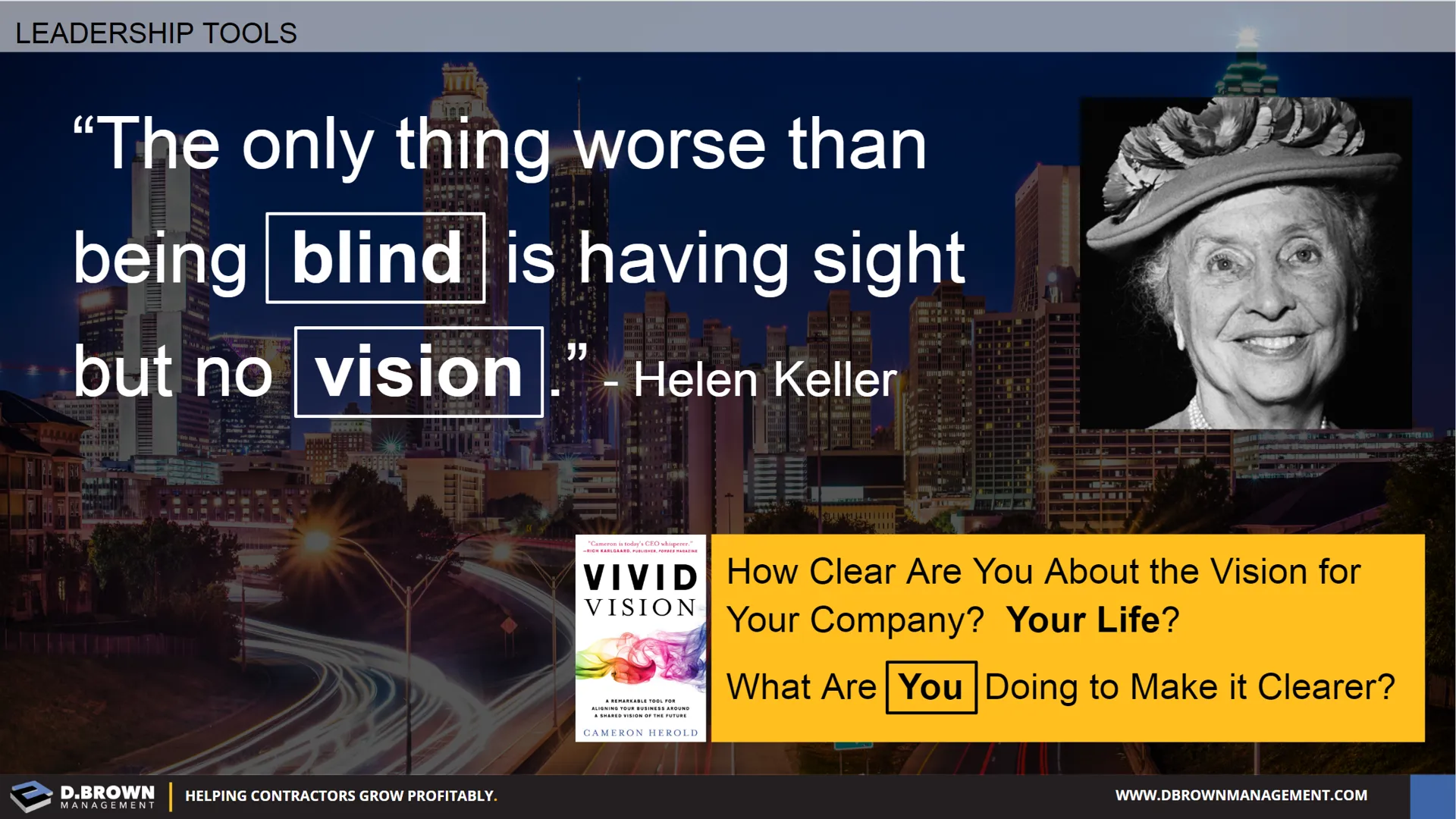
Quote: The only thing worse than being blind is having sight but no vision. Helen Keller.

A company’s vision is defined as the desired future position of the company.  

A company’s culture is defined as the behavioral norms of the group.  

More importantly as Rick Lochner points out - “The culture of any organization is shaped by the worst behavior the leader is willing to tolerate.”

Robin Dunbar’s research points to the average person being able to maintain about 150 stable relationships with team dynamics changing at certain sizes; approximately 5, 15, 50 and 150. 

Managing at each of these levels requires additional structure around communication and process.  This is required for operational effectiveness as well as aligning the team around what Cameron Harold describes as a Vivid Vision.  

At the project level it is nearly 100% about organizing information, material, equipment and labor to build things.  At the senior leadership level of a growing contractor it is nearly 100% about aligning the team around the right vision, mission, strategy and culture.


Creating Potential and Delivered Value for Contractors
We are contractors and the contract is a tangible representation of potential value. That value is delivered when the right information, materials, and equipment come together at the right time in the hands of the right craftsperson for installation.
Simple Math of Labor Savings
What would it be worth for your company to improve your field productivity? There is an incredible amount of low-hanging fruit to be picked when it comes to improving labor productivity.
Taxes - 4 Critical Aspects
Your taxes are most likely one of your top three expense categories. There are four critical aspects to them, starting with strategy, then modeling and planning, management, and preparation and filing. All are important and must work together over time.