Investing for Sustainability - Growth Hurts

“I can’t afford to invest more in talent development or process streamlining because we have a bunch of bad projects.”

D. Brown Management Profile Picture
Share

This may come from the different levels - for instance a crafts person who is too focused on individual productivity to train their apprentice.  It may come from the Project Manager who is too overloaded with work to train their Project Engineer.
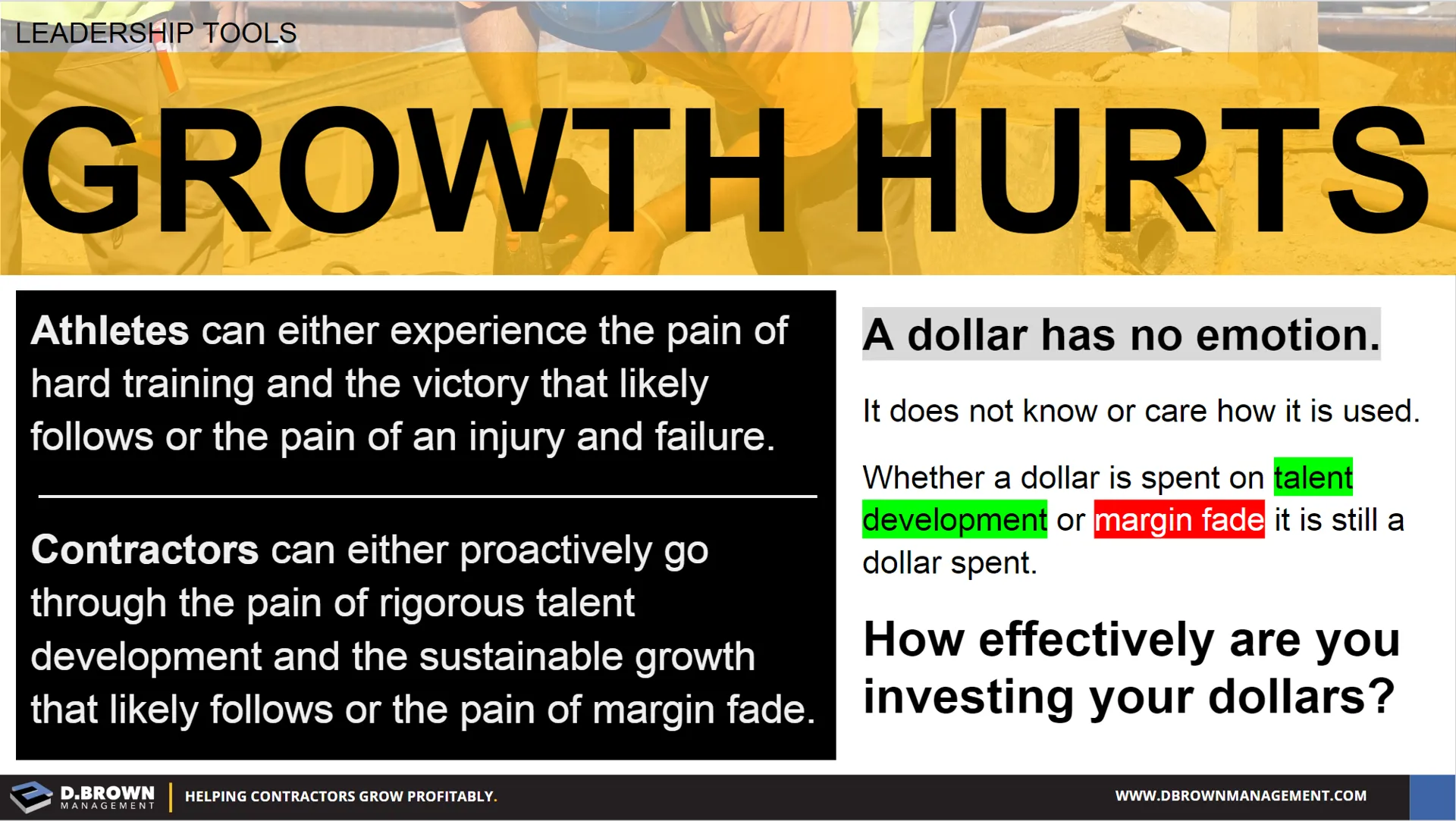
Leadership Tools: Growth Hurts. How effectively are you investing your dollars?

The only way a contractor can truly grow sustainably is to build a culture that is focused on continuous personal-development and teaching others.  Truly great development hurts - it stretches our brains to grow the same way physical exercise stretches our muscles. Most of your team will resist this level of exertion and insist there is an easier way.  Most of your team will rationalize away performance problems and downplay the need for training.  

The management teams of growing contractors systematically lead their teams through extremely rigorous training building them to dominate tomorrow’s construction environment.


Look at your business and the stage of growth it is in.  

Is your team prepared (or preparing) for the next stage of growth?

What pain are you avoiding today that will be 10X worse in the near future?  


Organizational Structures and Leadership Development
As contractors look at their organizational structures with an eye toward both sustainable growth and succession, they must balance the efficiency a functional area structure provides with the leadership development of a business unit structure.
Higher Scores Aren’t Always Better: Percent Planned Complete (PPC) Example
Construction is full of competitive personalities - where more is always better. But that isn't always true. When setting targets, be careful that your goals don't have unintended consequences. Percent Planned Complete (PPC) shows why.
Valuation Math - Multiple of Earnings
In a valuation, you will often hear the term multiple of earnings. This is usually calculated based on some average of the last 3-5 years earnings and weighted toward the more current years.