Levels of the Value Stream

For contractors to unlock maximum value during business development, preconstruction and project execution it is critical to understand the broader value stream of the project beyond their scope.

D. Brown Management Profile Picture
Share

Consider these 10 levels of granularity when looking at the construction value stream:
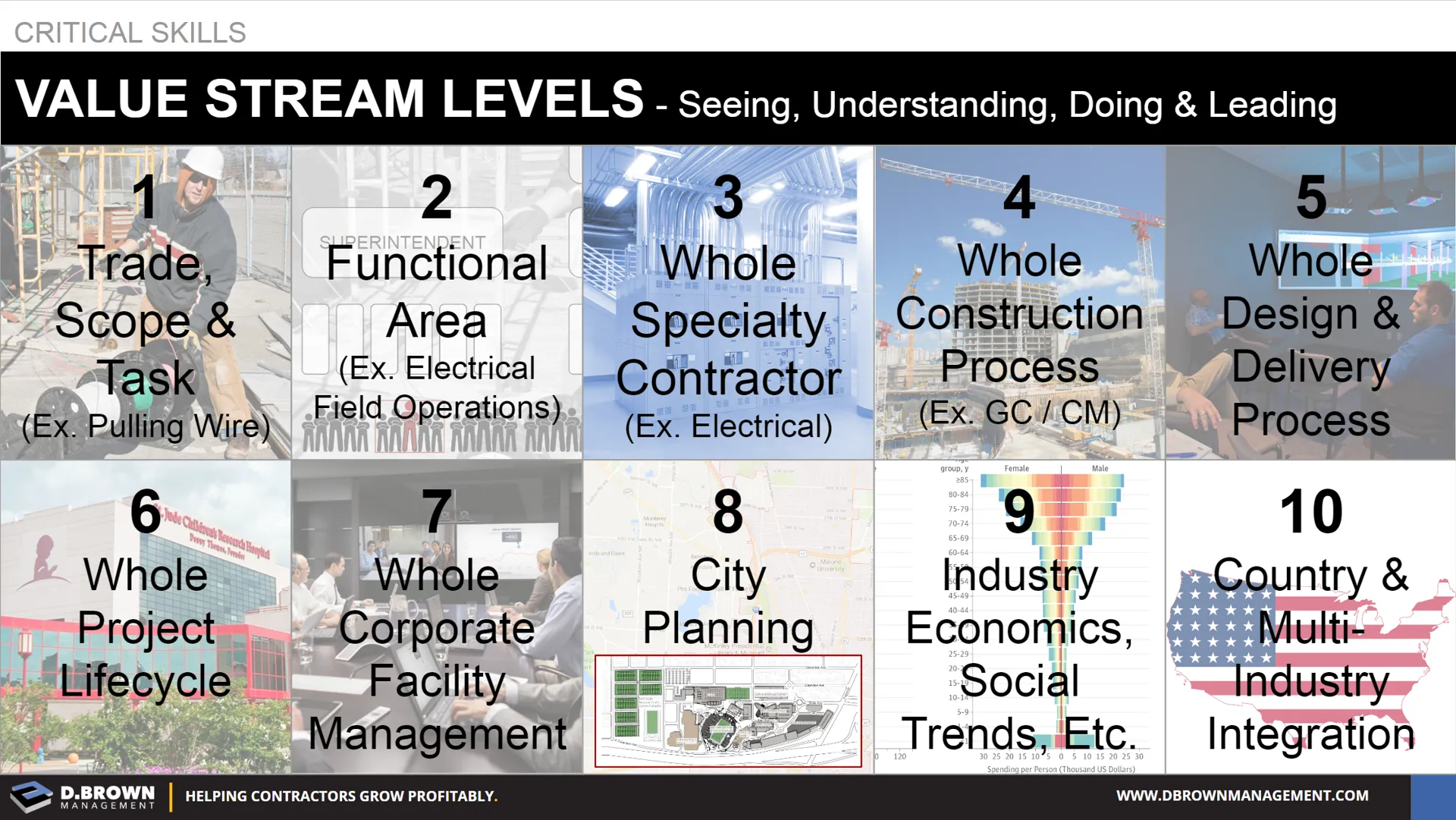
Critical Skills: Value Stream Levels. Seeing, Understanding, Doing, and Leading.


SPECIALTY CONTRACTOR

  1. Specific Trade Scope & Task (Field Installation Expertise)
  2. Functional Area of Specialty Contractor (Precon, Detailing, Prefab, etc.)
  3. Whole Specialty Contracting Business (Electrical, Mechanical, etc.)

PROJECT OWNER

  1. Construction Process (GC / CM Viewpoint)
  2. Design & Project Delivery Process
  3. Project Lifecycle (From Concept Through Initial Construction, Operation, Renovations & Decommissioning) 
  4. Corporate Facility Management (Interrelationships of Business Strategy & Multiple Project Lifecycles)

BEYOND

  1. City Planning (Redevelopment Vision, Supporting Infrastructure, etc.)
  2. Industry Trends (Example - Demographics Driving Healthcare Capacity Needs)
  3. Country & Multi-Industry Integration (Example - Growing Geographies, Integration of Housing & Healthcare)


What level of the value stream is your primary focus?

Deeply learn the value streams and build relationships 1 & 2 levels higher.  

What can you do to add maximum value considering the perspective from those higher levels?  


Bruce Lee - "Be Like Water"
Be like water - an amazingly simple and powerful piece of wisdom from Bruce Lee. As the construction industry continues to get more complicated sometimes it is important to back up and look at simplicity.
Process Improvement and Cycle Times
When contractors grow inefficient processes usually get substantially more inefficient dramatically changing the Return on Investment (ROI) model. Saving a few minutes over 1,000 cycles per month means $60K+ potential savings over a couple years.
Taxes - 4 Critical Aspects
Your taxes are most likely one of your top three expense categories. There are four critical aspects to them, starting with strategy, then modeling and planning, management, and preparation and filing. All are important and must work together over time.