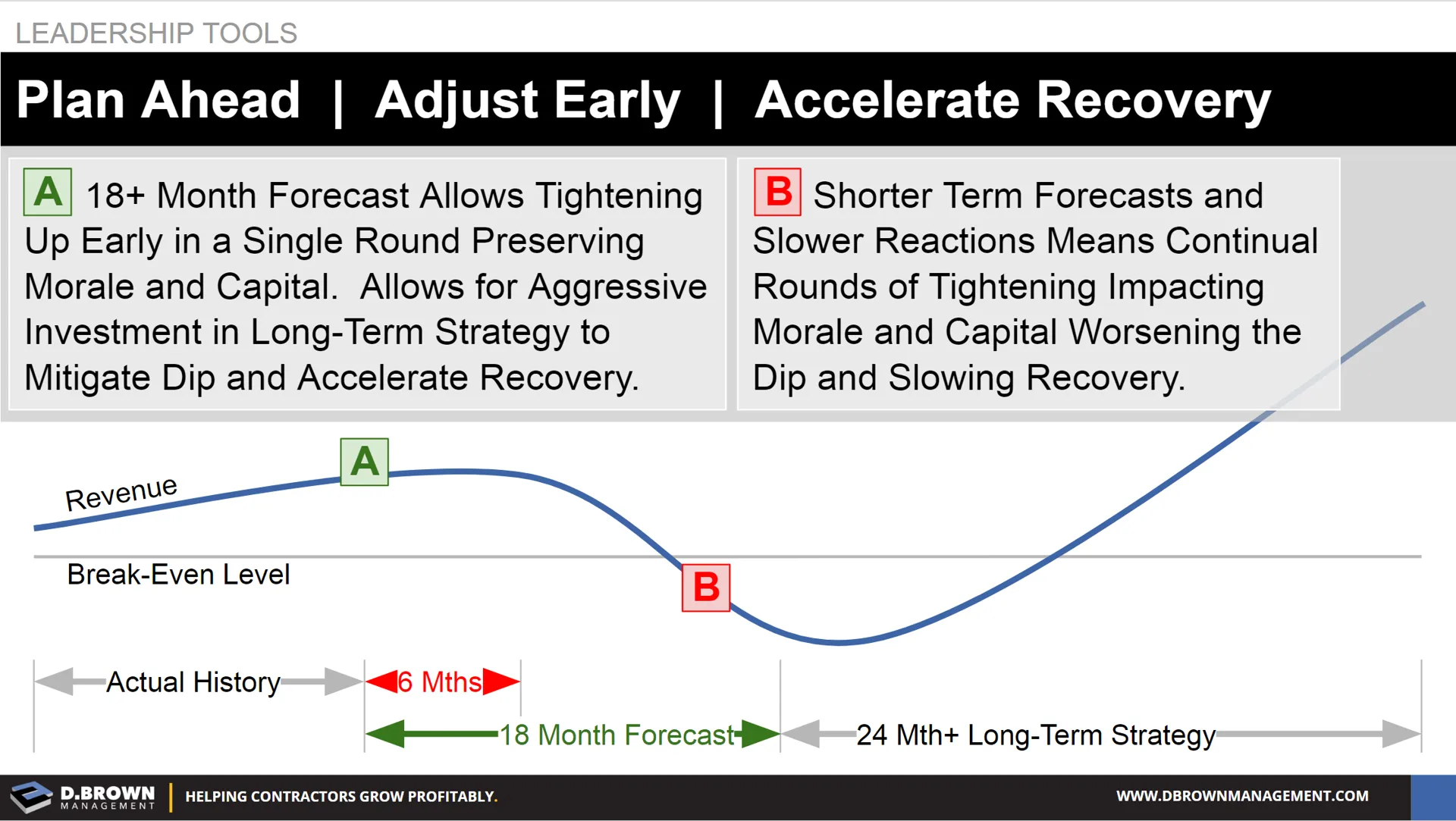
Plan Ahead, Adjust Early, and Accelerate Recovery

Construction in any given industry sector or geographical area is a cyclical business.

D. Brown Management Profile Picture
Share
Leadership Tools: Plan ahead, adjust early, and accelerate recovery.

There are four major levers a contractor can pull to ensure the business performs well throughout all economic cycles. 

  1. Diversifying across several counter-cyclical industry sectors and/or geographies.  
  2. Focus on cross-training core team members so they are agile enough to move between types of projects and even geographies as the market changes.  
  3. Develop aggressive and effective business development capabilities to be able to swim upstream like a salmon.  
  4. Build strong forecasting capabilities to be able to see a market softening well in advance and to act upon that quickly.  

Developing the people, processes, tools and discipline required to forecast out 18-24 months always makes teams stronger.  Exercising teams to really think through what would happen if either their business doubled or halved in the next 18-24 months it makes them more prepared for either. 


Schedule a meeting with our team to learn more about how we help contractors accelerate profitable growth  


Technology Systems – Seeing the Whole Picture
Construction technology systems from infrastructure through specialty applications are complex. Understanding all the major pieces, how they integrate, and how they help you achieve your strategy is critical for all levels of leadership.
Project Cash Metric and Cash vs. Margin Variance
Contracting is a very capital-intensive business and it is critical to constantly be watching cash flow performance. This metric is the highest level of an “OUTCOME” for cash flow at the project level, summarizing the performance of ops and accounting.
If a Problem is Worth Solving, It's Worth Solving All the Way
Not all problems are created equal and not all problems are even worth solving. When they are; be aggressive in solving them so they never come up again. Remember that 90% of continuous improvement is just about eliminating problems consistently.