Process Improvement and Cycle Times

When contractors grow inefficient processes usually get substantially more inefficient dramatically changing the Return on Investment (ROI) model.

D. Brown Management Profile Picture
Share

Saving 5 minutes per cycle for something done 100 times per month is only worth $6,000 over a couple years. At 1,000 cycles per month it’s worth investing up to $60,000 to make the process more efficient.  
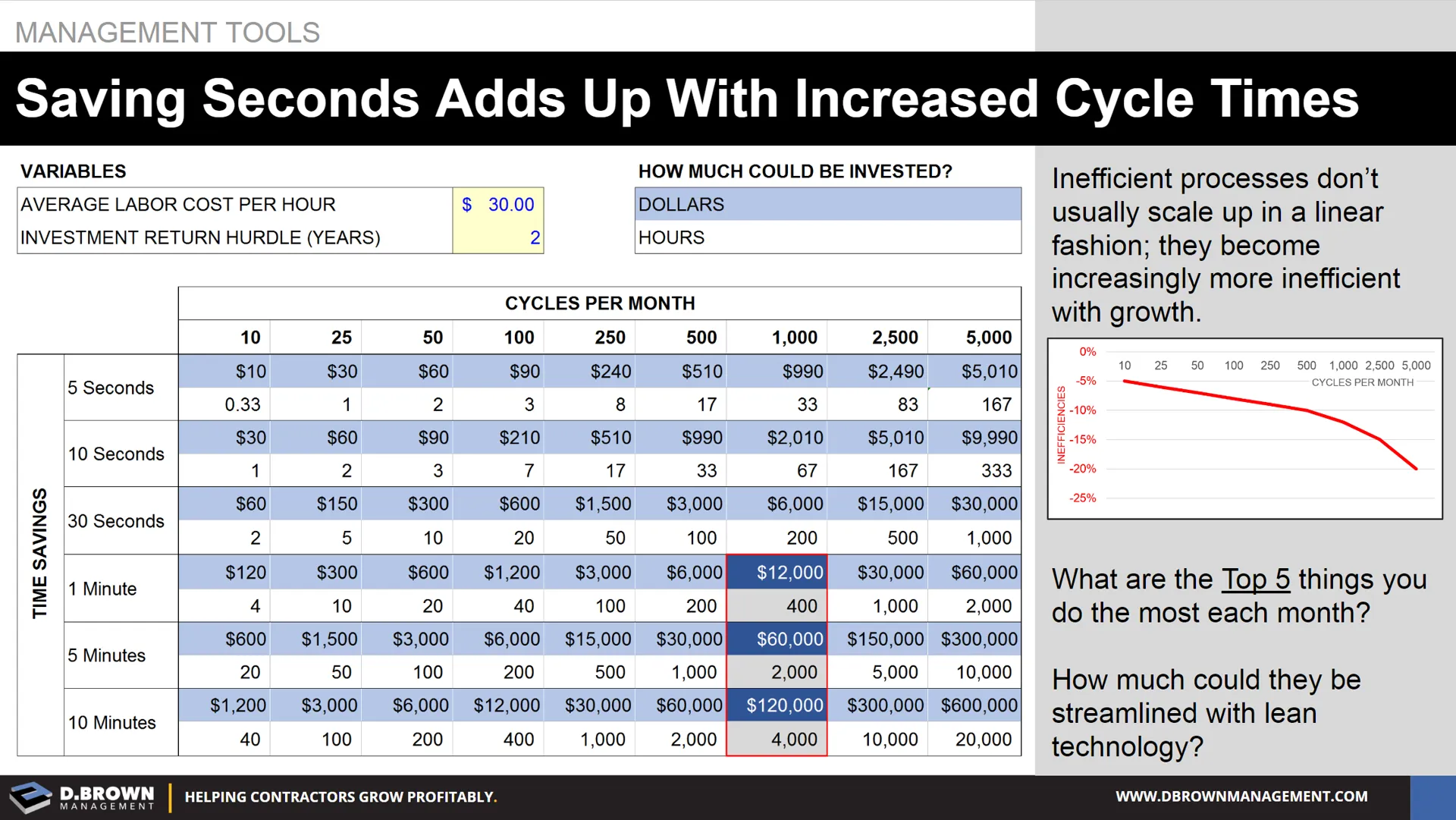
Management Tools: Graph representing Saving Seconds Adds Up with Increased Cycle Times.

Where are your opportunities?

Too many times as contractors scale they look primarily at the technology tools and get poor results. One factor often underestimated is the investment in rolling out the new standards versus just the cost of the technology

Corbins Electric and NOX Innovations are really good at is looking at the whole workflow, talent, culture and technology. They give a great example of this with their purchasing process improvement.  

Everything stated here seems easy enough but is VERY difficult to execute consistently.  The team at Corbins has done an amazing job balancing high-level strategic direction, culture and process streamlining.  They are also great about sharing with their peers in the industry.


Decision Quality: Data Points, Accuracy, Confidence, and the Danger Zone
Decision quality IS NOT linearly related to information quantity. In complex environments with elements of uncertainty, data quantity quickly reaches a point of diminishing returns but increases decision confidence, which puts you into the danger zone.
Using a Vision to Create Desire and Context for Tasks
There is a whole lot of work involved in building projects and building a construction company. It is easy to get mired down in endless to-do lists, processes, and problems. The thing that holds this all together and accelerates performance is the vision.
Selecting and Managing People for a Job Role
A job role is a collection of related tasks and decisions to achieve a set of outcomes. A person brings a wide range of desires, skills, and experience to that job role. Aligning these is the discipline of management.