
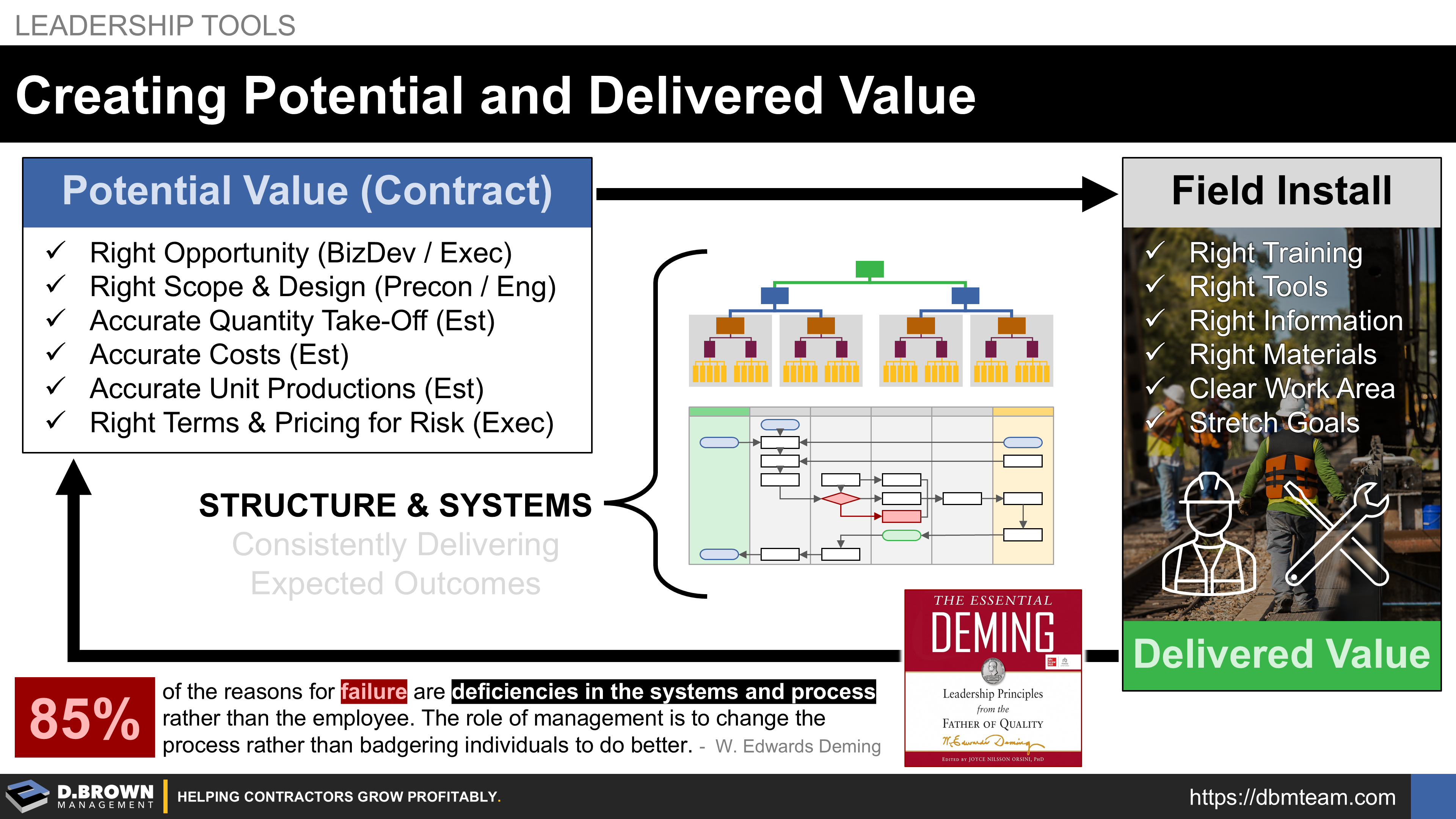
Once your strategic decisions are made about your markets, operations, and talent, the business of building is largely about winning work and building work. This will be the focus of most of your people and management systems.
"Eighty-Five Percent of the reasons for failure are deficiencies in the systems and processes rather than the employee. The role of management is to change the process rather than badgering the individuals to do better." - W. Edwards Deming
Identify priorities, bottlenecks, and constraints in your business by focusing on two critical milestones—the contract and field installation. Use this simple checklist for each to start your continuous improvement process.
The Contract (Potential Value)
- Identifying and choosing the right opportunities to pursue (BizDev & Executives)
- Defining the right scope, design, and schedule to deliver maximum value to the project owner (Precon / Engineering)
- Accurate quantity take-off (Estimating)
- Accurate costs including materials, equipment, subcontractors, and crews (Estimating)
- Accurate unit production rates given the conditions (Estimating)
- Right terms and pricing for the risk (Executives)
Field Installation (Delivered Value)
- Right field workforce—trained for the task(s) including field leadership
- Right tools and equipment
- Right information
- Right materials
- Clear work area
- Stretch goals
Achieving this in the field comes down to Effective Tasking, The 6 Pillars of Productivity, Short-Interval Planning (SIP), and ABC Daily Planning.
