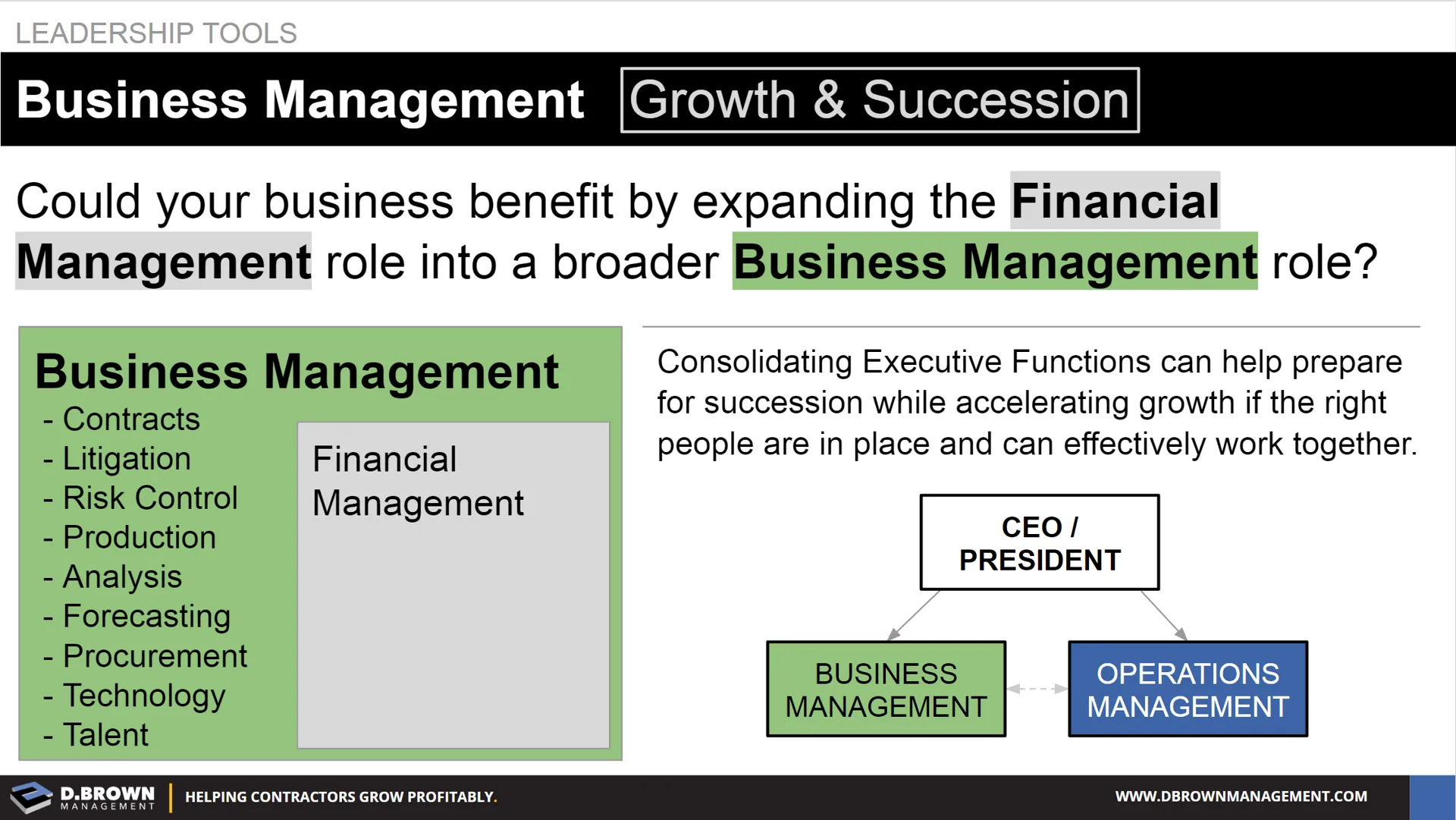
From Financial Management to Business Management

As contractors go through different stages of growth it often makes sense to expand the financial management role into more comprehensive business management role.

D. Brown Management Profile Picture
Share
Leadership Tools: Financial Management to Business Management.

At exactly what stage a contractor starts to expand this role depends on:

  1. Volume or work
  2. Complexity of work
  3. Complexity of the regulatory environment the contractor operates in
  4. Best Return on Time for other operating executives who are currently doing these functions

Of all these the best Return on Time for other executives is often the most overlooked.  Consider how much time some of these functions take other people in the organization.

Could their time be better spent:

  • Connecting with customers to help develop business?
  • Improving project execution?
  • Spending more time developing talent to build capacity for the future?

A fifth major factor includes succession - sometimes the owner/operator of the company is doing so many of these functions or managing so many direct reports that a clean succession is nearly impossible.  


Schedule a call with us to see if this makes sense for your organization


Change and Improvement (Expectations vs Reality)
Leadership at the company, team, and individual level starts with setting the direction, trajectory, and milestone goals. With that said, more failures occur due to failed execution rather than bad goals or strategy.
Giving and Receiving Feedback
Few things will enhance performance faster than deliberate practice, a rigorous feedback loop and enough cycles to build the competency. Here are the common challenges many people face.
Building a Systems Development Team - Management
The CPM (Critical Path Method) of project management is very commonly used in the management of construction projects. CPM works very well when the components of the design and the project are mostly known to all responsible parties.