Issue 3 of 9: Relationships

Construction Ownership Transition Issue 3 of 9: How Strong are the Post-Transition Relationships with Customers, Employees, Vendors and Subcontractors?

D. Brown Management Profile Picture
Share

Construction businesses rely heavily upon a network of interconnected relationships for their sustainable growth.  
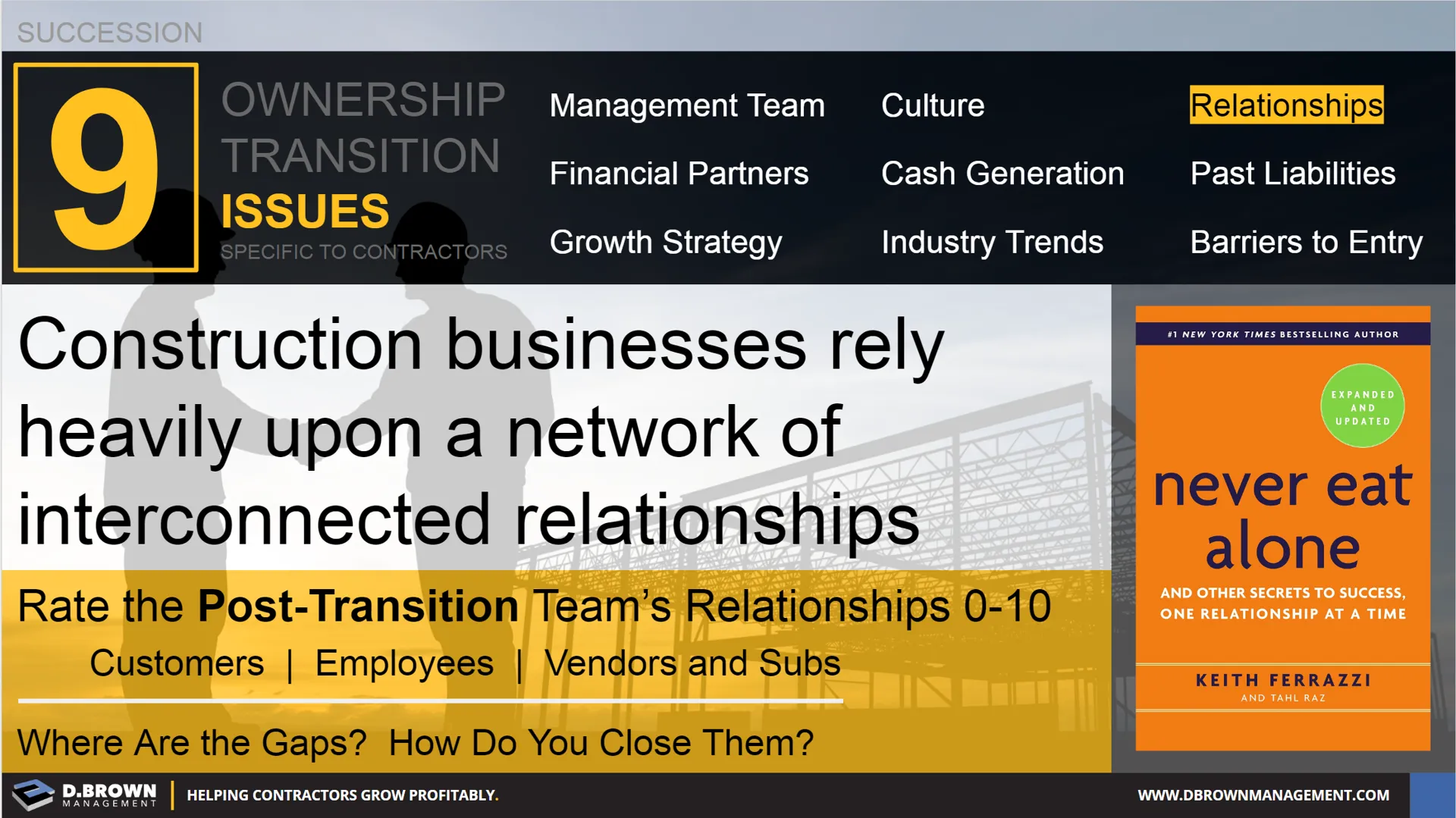
Succession: Ownership Transition Issues - Number 3 Relationships. Construction businesses rely heavily upon a network of interconnected relationships. Book: Never Eat Alone by Keith Ferrazzi.

These relationships are built on a foundation of trust over many years.  

  • Customers who know you will get the job done and do the right thing throughout the construction process, even when things go wrong.  
  • Employees who have seen how you have weathered the ups and downs of the business, including how fairly you have treated everyone even when there was no right answer.  
  • Vendors and subcontractors that are aligned with how your team works and will help you win critical projects.  
  • Financial partners, including the bank and surety and insurance companies that have confidence in how you manage through the inevitable ups and downs of the market.

Take a critical look at your post-transition management team and rate the quality of their relationships with each of these groups and down to the specific people.

Identify the gaps and develop a plan to close them.  

Never Eat Alone.


Issue 3 of 9: Relationships
Continue building value in your business, yourself and your key team members with a good succession strategy....

Issue 3 of 9: Relationships
Continue building value in your business, yourself and your key team members with a good succession strategy....

Foreman - Four Sometimes Competing Responsibilities
No other position in the construction industry has a bigger impact on field productivity than the Foreman who is leading the crew on front-line. There are four major responsibilities the foreman has that often seem to be competing with each other:
Management System Improvements (4 Interlinked Phases)
Many improvements fall short of expectations because steps are skipped in the earlier phases. Following these four phases will result in faster overall adoption of the changes, better outcomes, and most importantly, development of the team.
Change Management Workflow (From Identification-to-Payment)
For contractors to manage changes effectively, they must understand the entire change management workflow up through the project owner’s approval and payment process.