
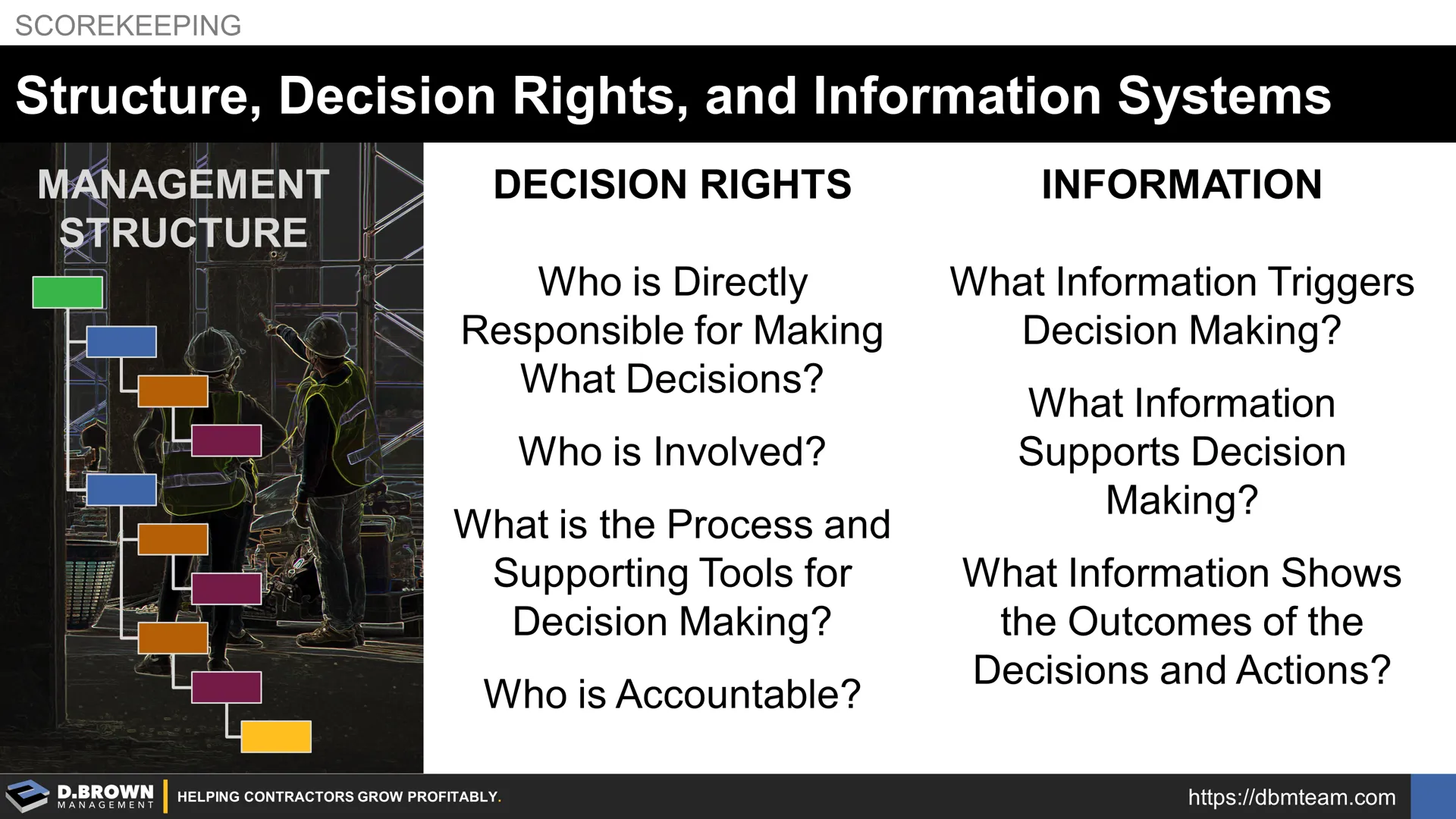
Management structures (hierarchies) are critical for success when they are enabling and not stifling.
Each job role and level must have clarity around their expected key results (outcomes), their decision rights, and the resources they have to achieve those results.
Decision effectiveness is a combination of:
- Experience of the people involved, including the person directly responsible for the decision.
- Information available upon which the decision is made.
- The decision process including supporting tools.
- Luck. All important decisions have a range of unpredictable external factors that creates a probabilistic set of outcomes, meaning that a "Good Decision" won't always have a "Good Outcome."
Learn More about the science of decision making - Thinking in Bets (Book) and Risk Schmisk (16 Minute Video) by Annie Duke.
Starter Questions About Decision Rights
- Who is directly responsible for making what decisions?
- What triggers those decisions? Event like a safety incident? Variation beyond a standard, like production on a project or past-due receivables? Regular timing like annual insurance renewals?
- When do those decisions have to be made?
- Who is involved in helping make those decisions and what roles do they play?
- What is the process and supporting tools for making that decision?
- What actions must be taken based on the decision?
- Who is accountable for ensuring the decision is made correctly, actions are being taken, and ultimately for the outcomes? This is different than the person who is directly responsible. See the differences between responsible and accountable.
Starter Questions About Information Systems Including Scoreboards & Scorecards
- What information triggers decision making?
- What information supports decision making?
- What information shows the outcomes of the decisions and actions?
- What is the right timing for this information?
- What is the right level of granularity for this information?
- What is the right delivery mechanism for this information?
Keep in mind that information is only a proxy for actual activities, and in a complex environment, more information does not equate to better decision quality.
