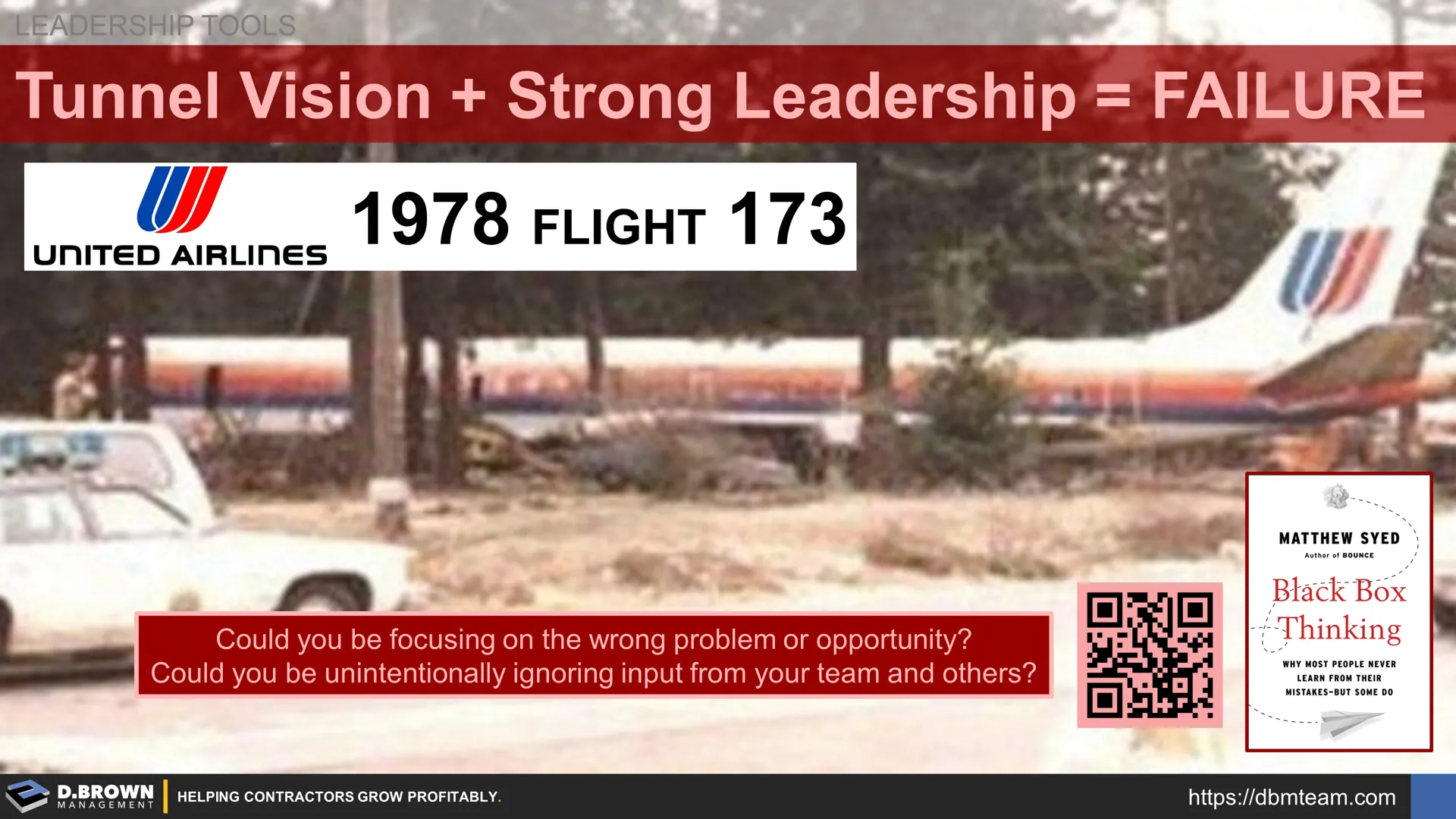
The Risks of Vision and Strong Leadership

The strongest leaders at all levels in construction have a clear vision of where they are headed and are relentlessly focused on achieving their goals. They align their teams tightly around the vision, goals, and strategy. This may introduce risks.

D. Brown Management Profile Picture
Share


Leadership Tools: Tunnel Vision and Strong Leadership equals Failure. Example: The 1978 United Flight 173.

This is absolutely the leadership required to bring a project out of the ground, set up a new department such as prefab, enter a new market, launch a new branch office or found a contracting business.  

As a contractor grows the leadership styles must also adapt along with the entire team dynamics. The airline industry has learned this through many failures including United Flight 173.  

It would be too easy to blame the captain, but similar incidents had occurred in the past. Root Cause Analysis pointed to deeper cultural and training issues. There hasn’t be an incident like this since.  

Our mission is to help contractors build stronger businesses for the next generation. We spend a significant amount of our time helping prepare leadership teams for succession and have learned many lessons along the way.  

Every failed succession we have seen has been a failure of talent not being properly aligned and not a failure of available capital or deal structure.  

Learn more


Balancing Training and Coaching Effectively
Every contracting business is made up of many jobs that need to be done, ranging from relatively simple and short-term tasks to complex, ambiguous, and long-term objectives.
Lead Measures and Outcomes: Starting with the Schedule of Values (SOV)
It is nearly impossible for a contractor to have consistently great cash flow if they have a Schedule-of-Values (SOV) that isn’t loaded properly and integrated with the project schedule, including a projection of the cash flow.
Contractor Growth Cycles and Decision Points
As contractors grow, they must make decisions and changes around five key areas. At these decision points, they may be experiencing some or all of the eight typical symptoms including stress, customer complaints, and inconsistent growth.