Appearance and Experience of Management Control

As your career develops and you grow into roles of greater responsibility, one of the biggest challenges is what Jennifer Garvey Berger calls “The paradox of the appearance of increasing control and the experience of decreasing control.”

D. Brown Management Profile Picture
Share

Read more in her excellent book on leadership development.  
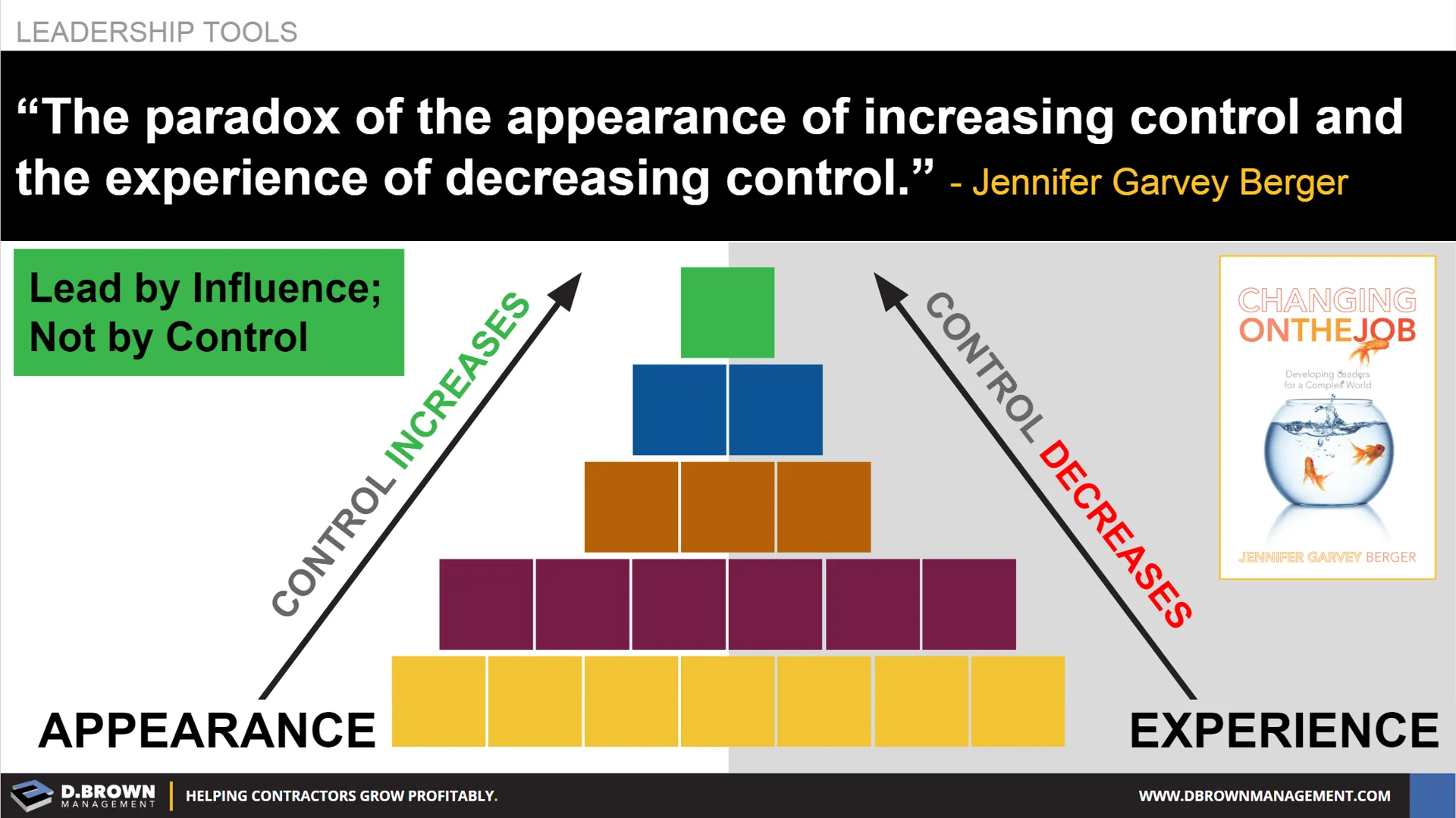
Quote: The paradox of the appearance of increasing control and the experience of decreasing control. Jennifer Garvey Berger.

When you are developing organizational structures for leadership development, planning your 2X structure, or preparing your leadership team for succession, it is critical to coach and mentor people through these different levels of management.  

Basically, each level of work from the front-line through the CEO requires a shift in two areas, though there is always a balance:

  • Less direct control over your team and more of a focus on leading through influence toward a common vision.  

  • Less reliance on hard technical skills and more of a reliance on soft skills, beliefs, and behaviors

Your leadership focus must evolve though this pyramid as your career and company grows. This growth isn't linear, and you will often find yourself moving throughout the pyramid based on the stage of growth that the company or your team is in.

When the growth of the business and the people get too far out of alignment, it can cause a variety of problems and ultimately show up on the scoreboard. These are the normal cycles of business growth.


Related Training

Structure, Decision Rights, and Information Systems
Alignment of strategy, management structure, decision rights, and information systems creates consistently good outcomes for growing contractors and faster development of talent.
Evaluation: Stage of Growth + State of Management Team & Systems
Management teams and systems develop through three phases at each stage of growth. Use these 7 steps to evaluate where your team is at.
Growth and Common Leadership Error Traps
Error traps are conditions that set people up to fail, not the failure themselves. This terminology is most frequently used around safety but applies to doing any activity effectively - including leadership. Learn three very common GAPs and mitigation.