Organizational Structures and Leadership Development

As contractors look at their organizational structures with an eye toward both sustainable growth and succession, they must balance the efficiency a functional area structure provides with the leadership development of a business unit structure.

D. Brown Management Profile Picture
Share

In a functional area structure, you avoid duplication of roles and individual functional areas such as estimating, purchasing, and field management are centralized. If executed effectively, this creates great efficiencies with the enabling bureaucracy required for scalability.
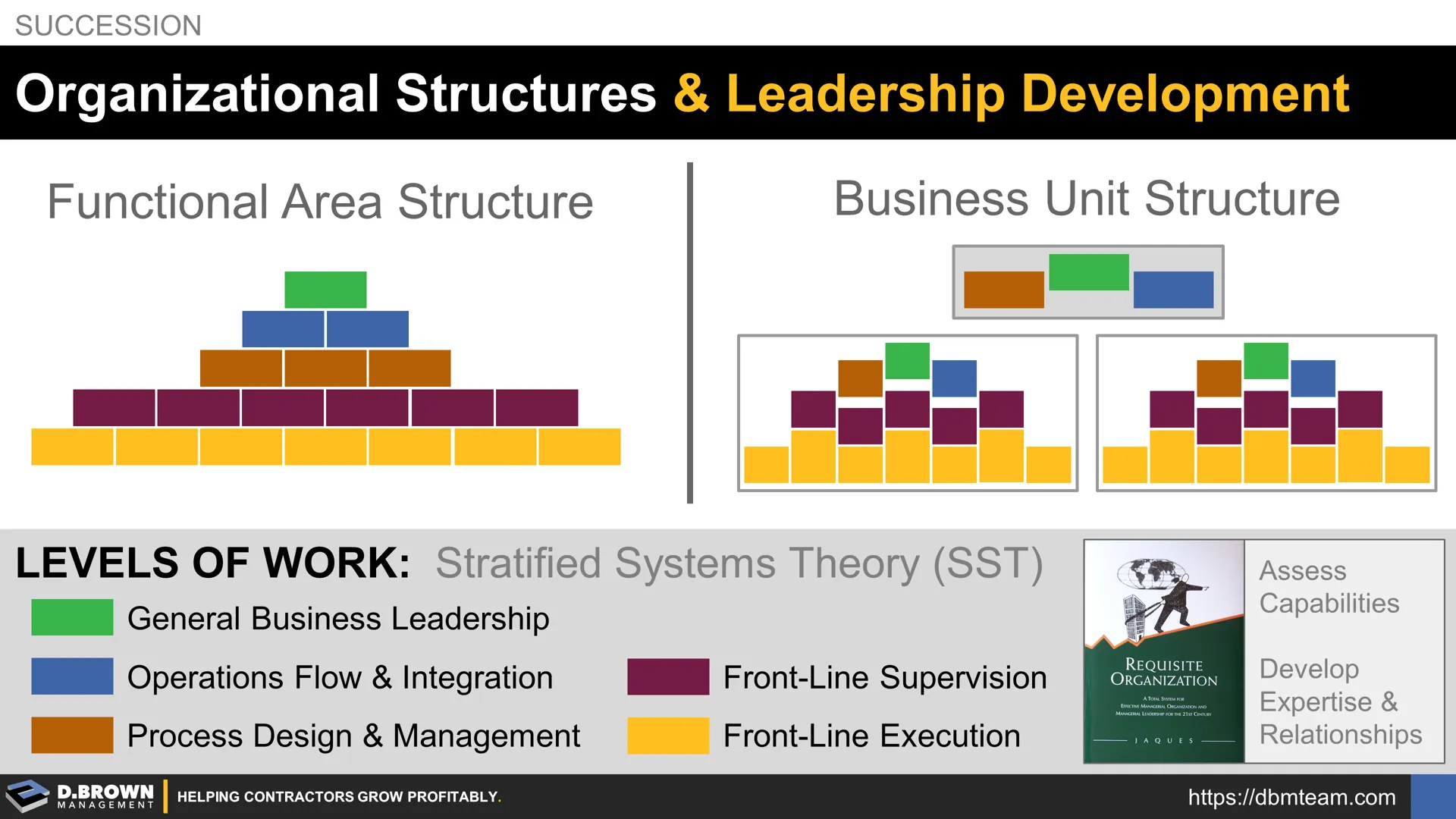
Succession: Organizational Structures and Leadership Development. A functional area organizational structure versus one aligned around business units down to a Project Manager. Levels of work including front-line execution, front-line supervision, process design and management, operations flow and integration, general business leadership. Stratified Systems Theory (SST).

For some contractors, it makes sense to break the business into smaller independent business units so broader general leadership skills can be developed and assessed. These individual business units are smaller and the job roles must be more fluid, which can be great for accelerating development and frustratingly messy at the same time.  

Just remember that compensation and accountability will not create competencies and both structures require deliberate development of the team.  

This is more challenging than we can cover in a short post. Please contact us if you want to further discuss the specifics of your organizational structure. 


Organizational Structures and Leadership Development
Continue building value in your business, yourself and your key team members with a good succession strategy....

Organizational Structures and Leadership Development
Continue building value in your business, yourself and your key team members with a good succession strategy....

Clear Installation Information
For a contractor to maximize their labor productivity, they need to start with clear information provided to the crews doing the actual installation. Good information is the first of the six pillars of productivity and means several things:
Evolving Focus with Growth and Leadership Levels
All contractors are built on the same foundation, which starts with the amazing crafts people. With growth in the business, project size, and your level of leadership, the time you allocate to different layers of the pyramid must evolve.
Lean Principle - People First (Then Process and Tools)
To optimize productivity, a contractor must focus on their people first, then processes and tools including technology as an integrated management system with a hierarchy. This is not a linear process: S.M.A.R.T. Experiments + Continuous Improvement.