
All roles within the organization require a different mix. Leaders must design their organizational structures to support their strategies, be able to evaluate people effectively then provide the training and coaching required to make them successful in their roles.
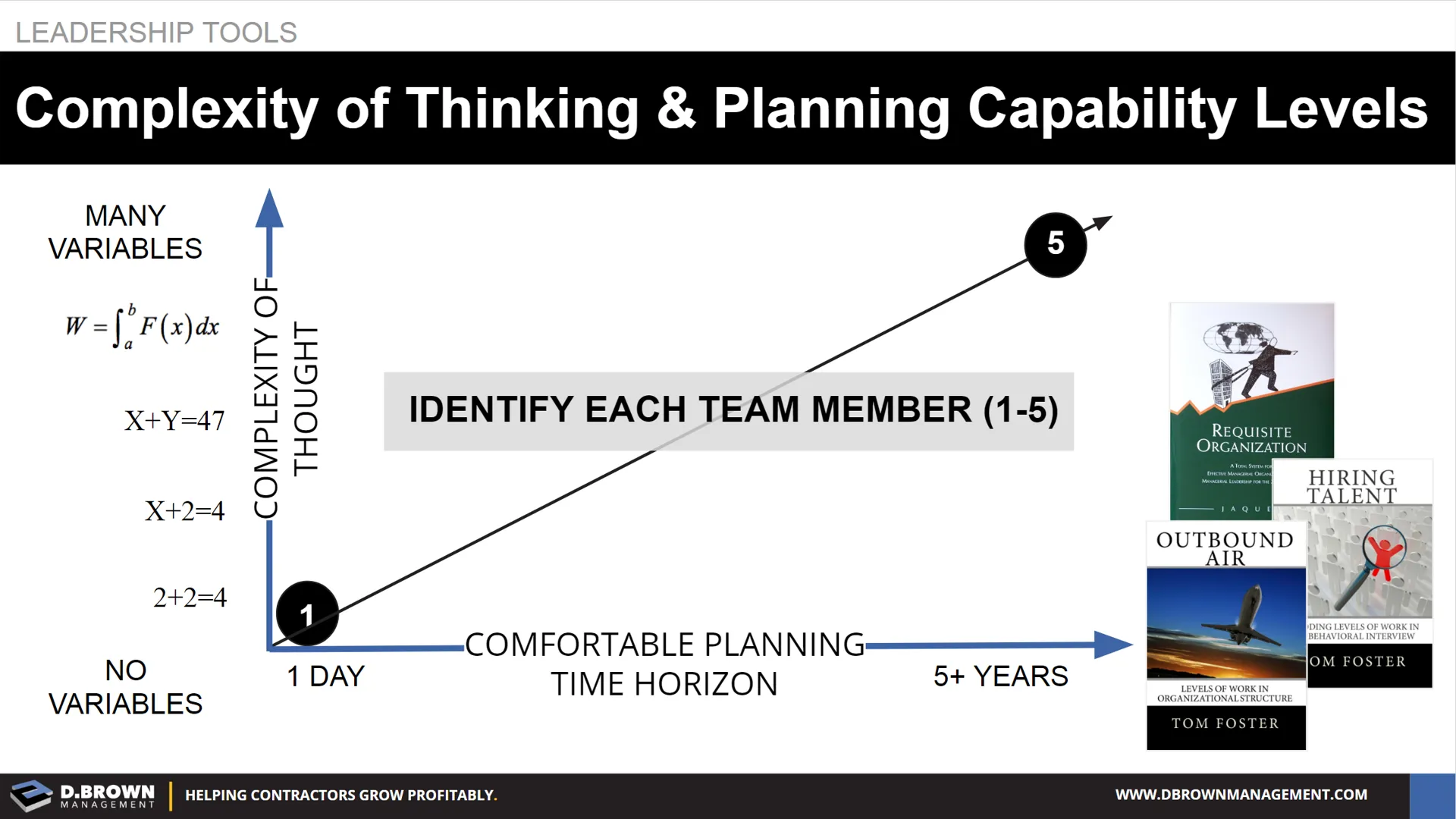
One of the critical dimensions is what Elliott Jaques called “Time Span of Discretion” which is essentially a combination of:
- Thought Complexity: How many variables can a person comfortably work with? At the simplest level are simple “this OR that” logic or statements such as 2 + 2 = 4. At the higher end is complex “IF...THEN” thinking with multiple variables and unknowns.
- Comfortable Planning Time Horizon: Over what period of time can a person comfortably create a plan when there are a lot of variables and unknowns? In the field we might consider certain crafts people in terms of how many hours they can work on their own without direction - this is the lower end of time span.
How would you evaluate yourself and your team? Contact us for simple scoring sheet.
Is your organizational structure aligned correctly to execute your strategy?
To effectively develop people?
Books & Videos
- Time Span 101 Video Series (Start Here)
- Hiring Talent (Book)
- Outbound Air (Book)
- Requisite Organization (Reference Book)
People Resources
- Tom Foster (Foster Learning)
- Heidi Mehltretter (PeopleFit)