Jack Welch - Any Jerk Short-Term Earnings

The ultimate measure of a leader is how well their business unit performs AFTER they are gone.

D. Brown Management Profile Picture
Share

Retired Navy submarine Captain David Marquet explains this very well in:
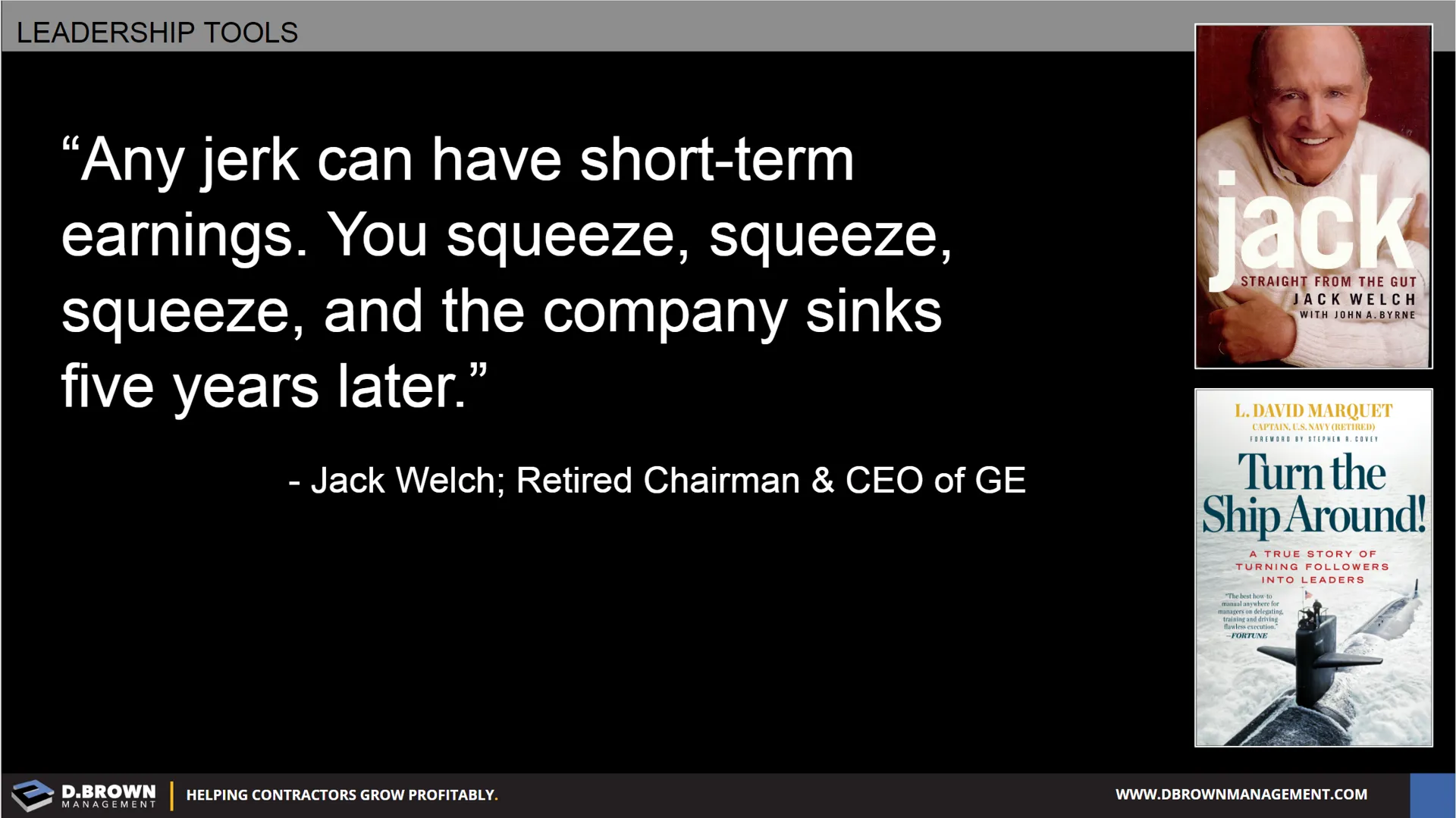
Quote: Any jerk can have short-term earnings. You can squeeze, squeeze, squeeze, and the company sinks five years later. Jack Welch Retired Chairman and CEO of GE.

With the construction industry heading into even bigger talent shortages it is critical that leaders focus on building other leaders.  This must be done at an accelerated rate just for contractors to maintain their market position and profitability.  

Jack Welch discusses this in his memoirs written after he left GE.  

Look at your organizational chart and ask the following: 

  • Who are your strong leaders?  
  • Who are your up-and-coming promising leaders?
  • Who can you trace their development back to?  
  • What training or coaching can you put in place to help your leaders become better people builders?

Evaluate all leaders in your company on the following.  Rate them 0-10 both in today’s demonstrated capabilities AND in what you believe they could be reasonably capable of in 3-5 years.  

  • Building the Projects
  • Building the Business
  • Building the People

Where are your strengths?  Where are your gaps?  

What can you do to leverage those strengths and close those gaps? 


Managing All Deliverables - Beyond the Basic Submittal Log
Maximize your people, projects, profitability, and customer relationships by making your submittal log and process a little less "efficient" and a whole lot more effective.
Project Delivery - CM Agency or Multi-Prime
Project Owners can minimize the markups for overhead and profit by contracting directly with the specialty contractors and hiring a Construction Management (CM) firm to work as their agent. This project delivery method is called CM Agency or Multi-Prime.
Governance Structures Enabling Ownership Transitions
Governance structures including the board of directors, policies, information flow, operating rhythm, and decision rights must continually evolve through each stage of growth and ownership transition. The first board is typically driven by a transition.